
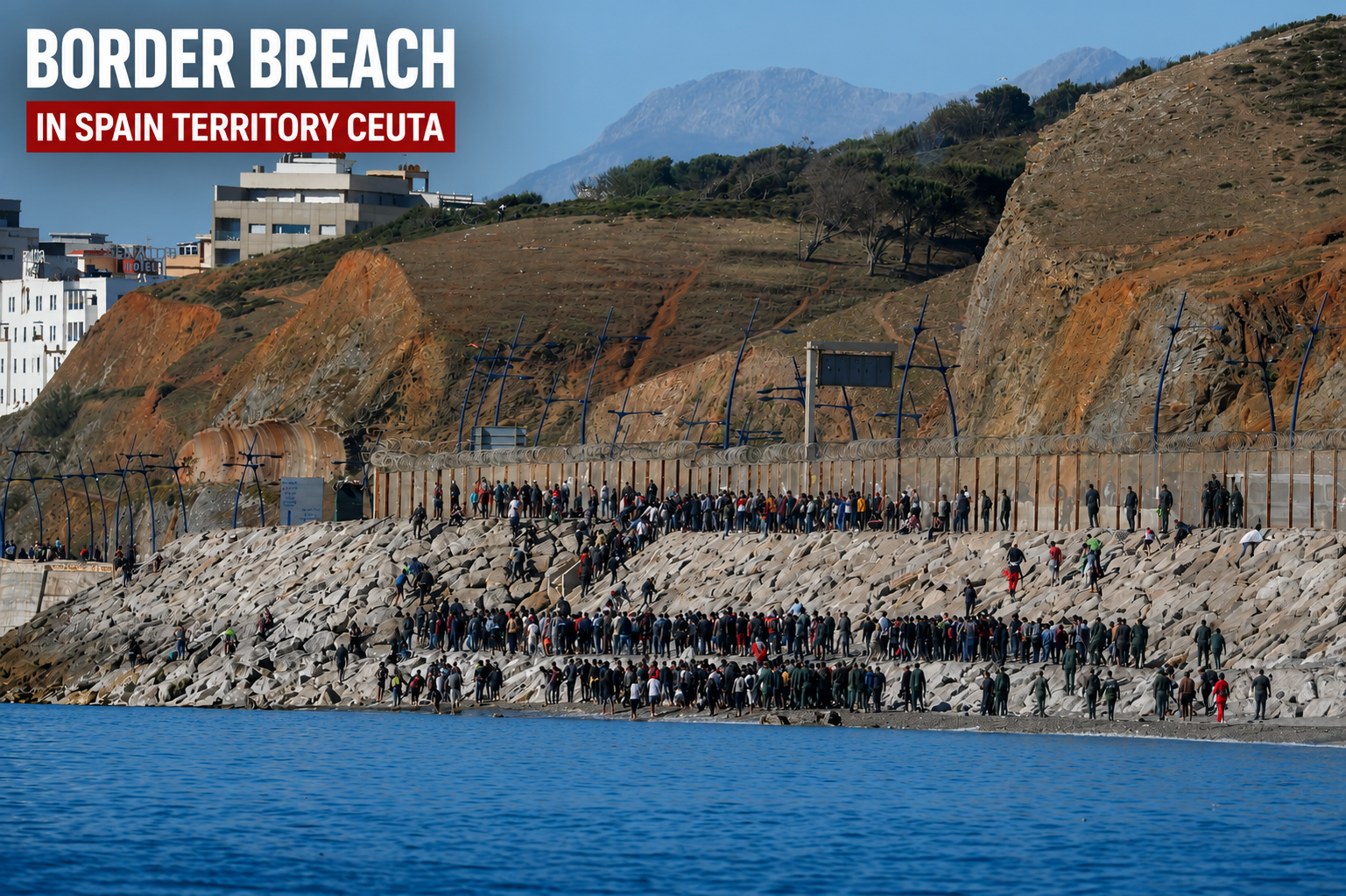
Ceuta, a tiny Spanish territory in North Africa, is facing a major border crisis after thousands of migrants crossed into the enclave from Morocco last week. The situation quickly descended into chaos, with at least nine people reported dead during the mass crossing.
The incident unfolded around Ceuta, a small Spanish autonomous city on the North African coast and one of the European Union’s most sensitive external borders. Spanish authorities said migrants entered by swimming around the Tarajal breakwaters and, in some cases, through gaps or breaches around the border area. Estimates reported by Spanish media and Reuters placed the number of arrivals at approximately 2,000 to 3,000 people, although officials said the exact figure was difficult to establish immediately.
The sudden arrival created severe pressure on Ceuta’s local services. Businesses in parts of the city closed amid the disorder, while local officials warned that the territory’s reception capacity was being overwhelmed. The situation also became deadly: Spanish authorities confirmed that at least nine migrants died during the latest crisis, while local officials have warned of a much wider death toll from dangerous attempts to reach Ceuta by sea in recent months.
Where Did the Migrants Enter Spain?
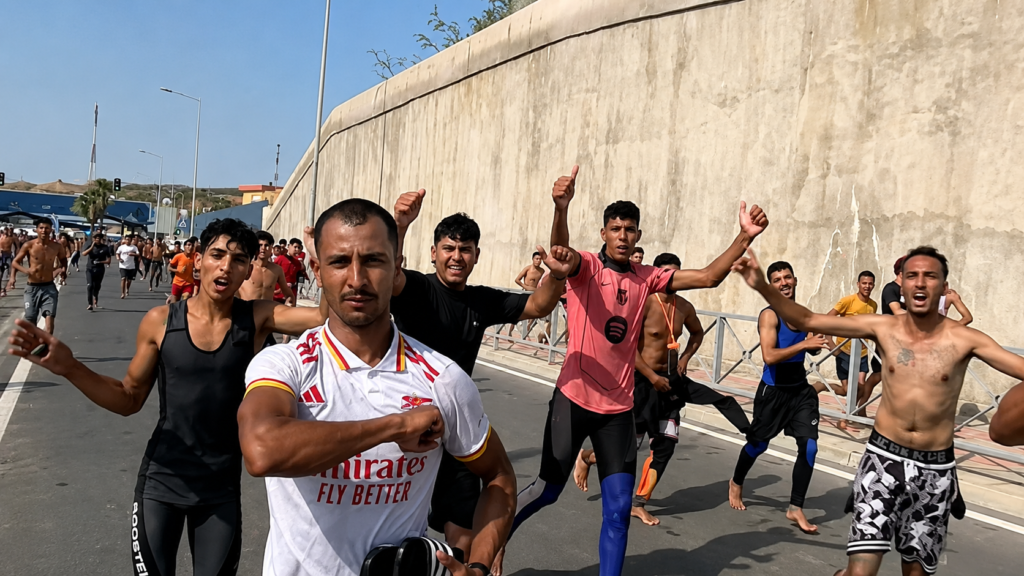
Ceuta is geographically located in North Africa but is part of Spain and therefore forms part of the European Union’s external border. It sits directly next to Morocco and is separated from mainland Spain by the Strait of Gibraltar.
The city has long been a major migration pressure point because reaching Ceuta means reaching Spanish and EU territory. The latest crossings were concentrated around the Tarajal area, where migrants attempted to reach Ceuta from nearby Moroccan territory.
Some of the migrants entered by swimming along the coast and around the breakwaters, while others moved toward the land border.
The scale of the movement was particularly striking because it happened within a short period. Local Civil Guard representatives described the situation as chaotic, with authorities struggling to determine the precise number of people who had entered.
Ceuta Authorities Call for Emergency Measures
The sudden influx immediately put pressure on Ceuta’s regional government.
Ceuta President Juan Jesús Vivas called for additional support from Spain’s central government and urged Madrid to consider declaring a national emergency over the situation. Spanish authorities, however, rejected the request for a national emergency declaration related to migration.
Local authorities were particularly concerned about the limited size of the territory. Ceuta has a population of roughly 85,000 people, meaning that even a few thousand unexpected arrivals can put enormous pressure on accommodation, security and public services.
The crisis also created concerns around the treatment and reception of migrants after their arrival, particularly because the number of people crossing was reportedly much larger than the territory’s immediate capacity.
Spain Sends Police and Military Reinforcements
Madrid responded by increasing security forces in the enclave.
Spain deployed around 200 specialised police officers and 60 military personnel to assist local forces and help restore order around the border. Maritime patrols were also involved as authorities attempted to prevent additional crossings and rescue people who entered the water.
Prime Minister Pedro Sánchez said the Spanish government was focused on providing an immediate response to the crisis and maintaining cooperation with Moroccan and international authorities. Interior Minister Fernando Grande-Marlaska was also expected to travel to Ceuta to assess the situation.
The government stressed that protecting Spain’s border and ensuring public safety were priorities, while also dealing with migrants who had already reached the territory.
Spain’s response therefore involved both security and humanitarian measures: reinforcing the border while authorities and rescue teams dealt with people arriving by sea.
Why Are Thousands Trying to Enter Ceuta?
There is no single explanation for the sudden surge.
One immediate factor identified in recent reporting is a Spanish Supreme Court ruling that limits the ability of authorities to immediately return intercepted migrants in certain circumstances. Spanish officials have argued that criminal organisations may be exploiting the legal situation and encouraging people to attempt crossings because they believe they have a greater chance of remaining in Spain once they arrive.
However, the reasons behind migration to Ceuta are broader than one court ruling.
For years, migrants have viewed Spain as a gateway into the European Union. Economic hardship, unemployment, political instability and difficult living conditions can push people to seek opportunities elsewhere. For migrants already in or near northern Morocco, Ceuta provides a geographically close route into EU territory.
The route is also particularly dangerous. Migrants have attempted to reach Ceuta by swimming, using flotation devices or crossing fortified border areas. The latest deaths demonstrate the risks involved.
Spanish officials have also pointed toward criminal networks and organised groups that can encourage or facilitate irregular migration. Moroccan authorities have similarly highlighted the role of criminal organisations in migration activity.
That makes them strategically important to Spain and the European Union.
The latest events also demonstrate how quickly a migration surge can overwhelm a small territory. A few thousand arrivals may be manageable for a large country, but in a densely populated enclave such as Ceuta, the same number can put immediate pressure on accommodation, policing, healthcare and local services.
What Happens Next?
Spain is now trying to regain control of the border while working with Morocco to prevent another large-scale influx.
The immediate priorities are expected to be preventing additional crossings, dealing with people already inside Ceuta, investigating the deaths and maintaining security around the border. Madrid must also balance its response with legal obligations concerning asylum seekers and migrants.
For Morocco, the episode is another test of its role as Spain’s key partner in managing migration toward Europe.
And for Spain, the crisis is likely to intensify an already heated domestic debate over immigration and border policy.