
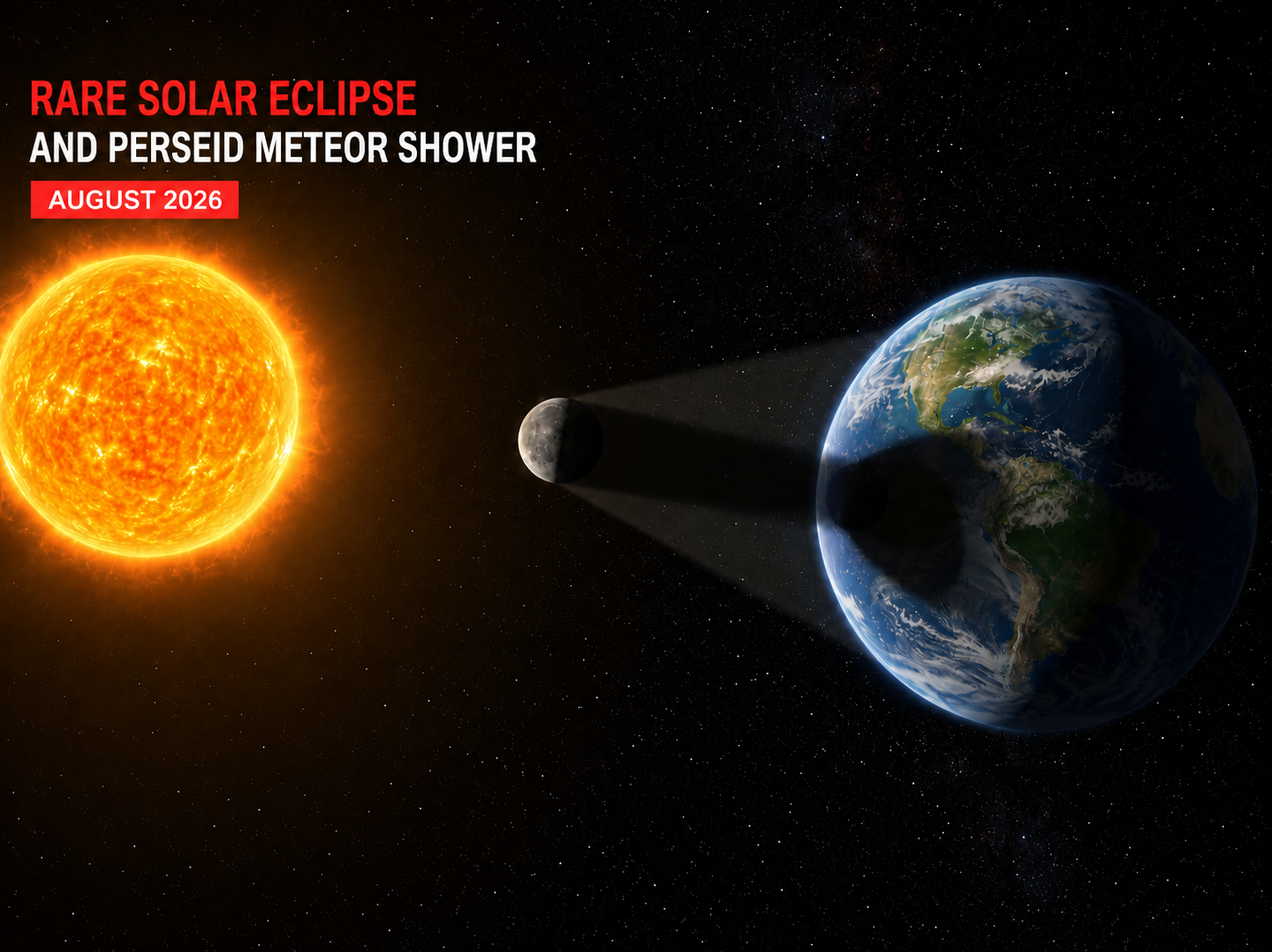
The night sky is about to deliver one of 2026’s most extraordinary astronomical events ( Rare Solar Eclipse and Perseid Meteor Shower August 2026), On August 12, a rare total solar eclipse will be followed just hours later by the peak of the Perseid meteor shower, giving skywatchers an unusual celestial double feature. While the eclipse will only be visible from specific parts of the world, millions of people can still enjoy the spectacular meteor shower after sunset under some of the darkest skies of the year.
Here’s everything you need to know about this remarkable August sky event.
A Rare Combination of Two Major Sky Events ( Rare Solar Eclipse and Perseid Meteor Shower August 2026 )
Solar eclipses and meteor showers occur regularly on their own, but seeing a total solar eclipse and the peak of one of the world’s most famous meteor showers fall on the same date is exceptionally uncommon.
The total solar eclipse will take place during the daytime on August 12, 2026, while the Perseid meteor shower is expected to reach its peak during the night of August 12–13.
Although the two events are not physically connected, their timing creates a memorable day for astronomy enthusiasts around the world. Adding to the excitement, the Moon will be close to its new moon phase, leaving the night sky much darker and making faint meteors easier to spot.
Where Will the Total Solar Eclipse Be Visible?
The eclipse’s path of totality where the Moon completely blocks the Sun will pass through:
- Greenland
- Iceland
- Northern Spain
Observers within this narrow path will experience a few breathtaking minutes of daytime darkness as the Sun is completely covered.
A partial solar eclipse will also be visible across large areas of Europe, parts of North Africa, and the North Atlantic.
Anyone planning to observe the eclipse should use ISO 12312-2 certified solar eclipse glasses or other approved solar filters. Looking directly at the Sun without proper eye protection can cause permanent eye damage.
Perseid Meteor Shower Takes Over After Sunset
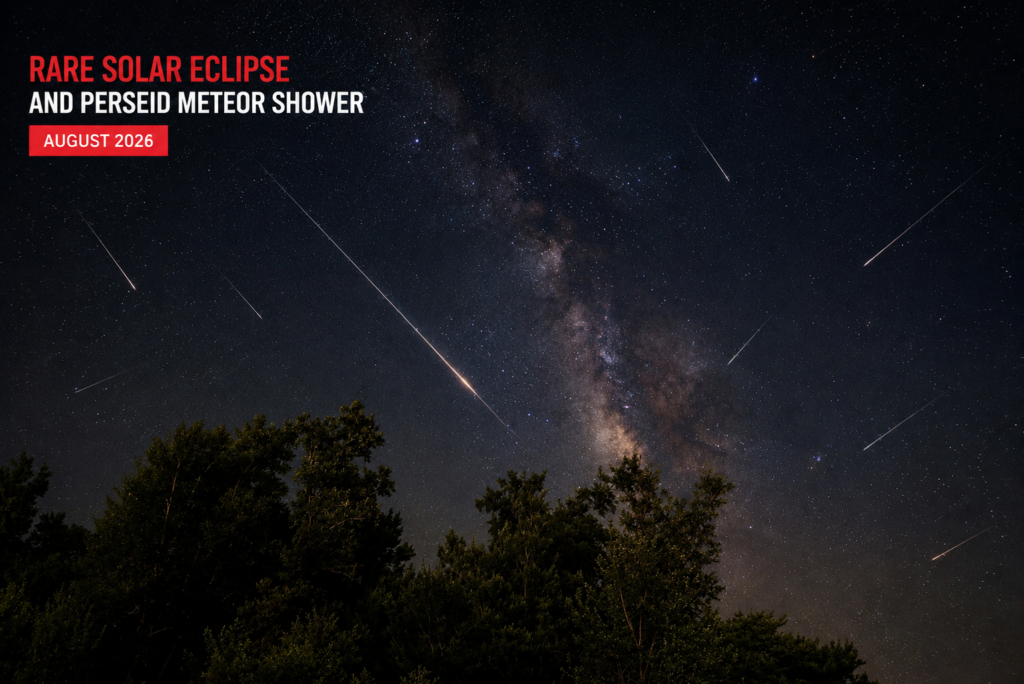
Once darkness arrives, attention shifts from the Sun to the stars.
The Perseid meteor shower, created by debris left behind by Comet Swift-Tuttle, is expected to reach its annual peak during the night of August 12–13.
Under ideal conditions, observers in dark-sky locations may witness up to 100 meteors per hour, including occasional bright fireballs that leave glowing trails across the sky.
You know why This is cool and worth watching, this year’s viewing conditions are especially favorable because moonlight will be minimal, allowing even fainter meteors to become visible.
Can You Watch It From India? ( Rare Solar Eclipse and Perseid Meteor Shower August 2026 )
Skywatchers in India are unlikely to see the total solar eclipse because the eclipse path does not cross the country.
However, there is still good news.
The Perseid meteor shower will be visible from India, weather permitting. The best time to watch is after midnight until just before dawn on August 13, when the radiant point in the constellation Perseus climbs higher into the northeastern sky.
For the best experience, head to a location away from city lights, avoid bright screens for about 20 minutes so your eyes can adjust to the darkness, and simply look up. No telescope or binoculars are required.
Tips for the Best Viewing Experience
If you plan to watch the Perseid meteor shower, a little preparation can make a big difference.
- Choose a dark location far from city lights.
- Check the weather forecast for clear skies.
- Give your eyes 20–30 minutes to adapt to the darkness.
- Avoid looking at your phone frequently.
- Bring a reclining chair or blanket to comfortably watch the sky.
- Be patient, as meteors appear randomly throughout the night.
Why the Perseids Are So Popular
The Perseids are considered one of the best meteor showers every year because they are both bright and reliable.
As Earth passes through the trail of dust and rocky debris left by Comet Swift-Tuttle, those tiny particles enter Earth’s atmosphere at incredible speeds—around 59 kilometers (37 miles) per second. Friction with the atmosphere causes them to burn up, creating the brilliant streaks of light commonly known as “shooting stars.”
Many Perseid meteors also leave glowing trails that remain visible for several seconds, making them especially impressive to watch.
A Skywatching Event Worth Marking on Your Calendar ( Rare Solar Eclipse and Perseid Meteor Shower August 2026 )
August 12, 2026, promises to be one of the year’s biggest astronomy dates. While only a limited region of the world will witness the dramatic total solar eclipse, millions more will have the opportunity to enjoy the dazzling Perseid meteor shower later that same night.
Whether you plan to watch it with your partner, family, friends, or simply enjoy a peaceful moment on your own, this rare celestial double event is the perfect excuse to step outside, leave the city lights behind, and create a memory beneath a sky filled with shooting stars. If you’ve been waiting for a special night to share with someone you love, this might just be it.
Quick Facts
| Event | Details |
|---|---|
| Total Solar Eclipse | August 12, 2026 |
| Path of Totality | Greenland, Iceland, Northern Spain |
| Perseid Meteor Shower Peak | Night of August 12–13, 2026 |
| Peak Rate | Up to 100 meteors per hour under dark skies |
| Best Viewing Equipment | Naked eye |
| Visible from India | Meteor shower: Yes (weather permitting); Total solar eclipse: No |